A Few Habits I Use to Keep Midweek Dinners Affordable
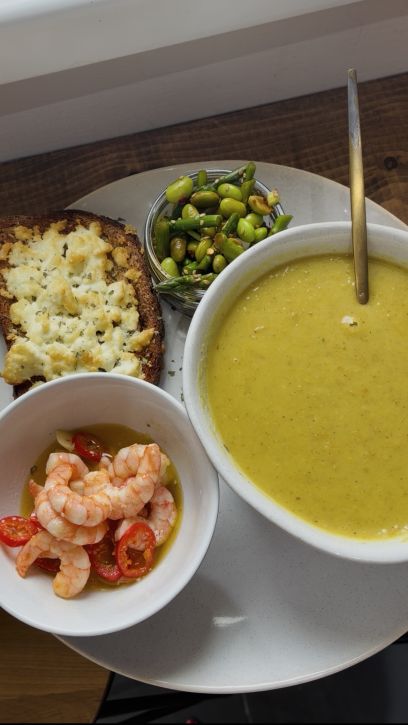
I thought I’d share a few of the little habits I try to apply to our midweek dinners to keep things affordable, without compromising on variety or the quality of what we’re eating.
Leftovers night
First up: leftovers night at least once a week.
I really try not to waste a thing where I can. Everything from broccoli stalks to leftover carrots can go into another meal — soups are an obvious one, but there are plenty of other options too.
I’ll often bulk a soup out with a little handful of lentils, for example, which adds some extra protein and fibre and makes the pot go even further.
Then the pot of soup itself can do lunches tomorrow, making use of those leftovers once more. I love a meal that just keeps on giving!
Keep things varied
Variety is another big one for me. It’s good for your gut, gives you a wider range of nutrients, and it also puts you in a much better position to make use of offers and seasonal produce.
I often leave my veggie sides fairly “open” rather than going into my shop with a very set list.
If broccoli is on offer, great. If there’s some lovely seasonal produce available, I can work that in instead. I find this gives me a bit more flexibility when I’m shopping and means I’m not tied to buying a very specific list of ingredients regardless of what’s available or what’s on offer.
Buy in bulk
Where it makes sense, I try to buy in bulk — whether that’s meat, spices or other things we know we’re going to use regularly.
If you’ve got the freezer or pantry space, it can be a really simple way of making your money go a little further.
I’m definitely someone who likes having a well-stocked freezer and pantry so that I’ve always got something to work with!
Buy frozen
And on that note… don’t overlook frozen food!
Frozen vegetables and fruit can often be cheaper, with a lower price per kg, and the quality and convenience can be an added bonus too.
There’s something particularly useful about having frozen veg to hand for midweek meals. You can take out exactly what you need, rather than having half a fresh cauliflower sitting in the fridge waiting to be forgotten about.
Make the most of deals
If there are good deals on things we already eat, I’ll absolutely make the most of them.
If I see something like 3 for £10 on meat or fish, for example, I’ll stock up and freeze what we’re not going to use immediately.
I also don’t think we should be scared of cheaper cuts of meat. Things like bone-in cuts, or slightly higher-fat cuts, can be brilliant options.
They can provide additional nutrients and help to keep us feeling fuller for longer, so portions don’t necessarily need to be as big if what you’re eating is more nutrient-dense.
For me, it’s about looking at the overall value of what you’re buying, rather than simply looking for the cheapest price tag.
Peel and chop it yourself
Another little money saver: buy the bigger bags of vegetables and peel and chop them yourself.
Wonky veg is also a great option. If it tastes the same, I really don’t care whether my carrot is perfectly straight! ?
I’ll buy a bigger bag and then plan that vegetable into multiple meals throughout the week.
Fresh, pre-chopped vegetables can obviously be really convenient, but you’re also paying for that convenience. Where I have the time, I’d much rather buy the bigger bag and prep it myself.
Frozen veg is absolutely fine pre-chopped too, but when it comes to fresh veg, I generally prefer to do the chopping myself. Pre-chopped fresh options can also be more liable to oxidation, and additives may be used depending on the product.
Shop online
And finally… shopping online.
I know this one can be controversial, because I still really like going into shops, and I try to visit and support local farm shops and health food stores nearby as often as I can.
However, for a bigger supermarket shop, I actually find that shopping online helps me track and see the prices much better.
You’re less likely to be influenced by all the sights, offers and clever marketing tricks in-store, and you get to see your total basket spend before you actually buy everything.
I’ll either opt for click & collect somewhere nearby, or pick a saver delivery slot, where you have a slightly more flexible delivery window.
I’d like to think that’s also a little better for the environment if the van is already passing by and can just drop my shopping off along the way — so, win-win!
And that's about it!
Those are just a few of the habits I try to apply to our midweek dinners to help keep things affordable.
For me, it’s not about making food shopping as cheap as possible or constantly cutting things out. It’s more about being a bit savvy with what I buy, making the most of what we already have, and being flexible enough to take advantage of seasonal produce and good offers.
Unrefined sea salt, harvested by hand and infused with 13 fresh organic herbs & vegetables

- Enhance your favourite dish with Herbamare®
- 100% natural and unrefined sea salt
- Infused with 13 fresh organic herbs and vegetables
- Free from artificial flavours and preservatives
- No MSG or GMO
 Looking for a healthier alternative to regular salt? Well, look no further!