A.Vogel search
When the internal search is activated, personal data such as your IP address is transmitted to our search engine Cludo. Data is thus transferred to a third country. Please click here if you want to display the internal search. You can find more information on data protection here: Privacy policy.



A.Vogel Atrogel Arnica Gel - Soothing Relief for Muscle Pain, Bruising, Joint Pain, Sports Injuries, Stiffness & Swelling - Natural Plant-Based Arnica Montana Extract Gel | 50ml


A.Vogel Atrogel Arnica Gel - Soothing Relief for Muscle Pain, Bruising, Joint Pain, Sports Injuries, Stiffness & Swelling - Natural Plant-Based Arnica Montana Extract Gel | 50ml
- Made with Fresh Arnica Montana for Natural Pain Support - Contains a high-quality extract of fresh Arnica montana to support the relief of muscle aches, joint pain, stiffness, and post-exercise soreness naturally.
- Supports Recovery After Sports, Exercise & Physical Activity - Ideal for athletes and active individuals, this non-greasy gel is designed to help ease muscle tension, swelling, and bruising after physical exertion or minor injury.
- Non-Greasy, Cooling Gel That Absorbs Easily Into the Skin - Applies smoothly and absorbs well without leaving a sticky or oily residue, making it a convenient choice for regular use after training or daily movement.
- Helps Soothe Bruises, Strains, and Swelling from Minor Injuries - Formulated to support the body’s natural healing process, this arnica gel is ideal for bruising, sprains, and minor sports-related injuries or overuse.
- Trusted Herbal Formula Used by Healthcare Professionals - Developed by A.Vogel and backed by decades of expertise, this plant-based topical gel is widely recommended by practitioners for external use on sore muscles and joints.
Atrogel® Arnica gel is a traditional herbal medicinal product used for the symptomatic relief of muscular aches, pains and stiffness, sprains and bruising, exclusively based upon long-standing use as a traditional remedy. Always read the leaflet
Atrogel® is made from extracts of fresh Arnica flowers and is an easy-to-apply non-greasy gel. It can be used up to 4 times a day.
Atrogel® Arnica gel may be used to relieve muscular pain and bruising in adults, children and the elderly. Apply 2 to 10 cm of the gel gently to the affected area. Use between 2 and 4 times daily for pain relief.
Don’t use Atrogel® if you have broken or irritated skin, if you are allergic to arnica preparations or other members of the daisy (Asteraceae / Compositae) family, or any of the other ingredients.
The active ingredient is the liquid extract of fresh Arnica flowers. 1g of gel contains 500mg of extract which is equivalent to an average of 160mg fresh Arnica flowers. The other ingredients are ethanol, purified water, glycerol (plant origin) and ammonium acryloyldimethyltaurate/VP copolymer (thickener).
After opening, store below 25oC and use within 6 months.
Like all arnica products used externally, Atrogel® Arnica gel can cause side effects, although not everybody gets them. Minor side effects can occur when using Atrogel® Arnica gel. These are likely to affect less than 1 in every 10 people and may take the form of skin reactions (itching, skin rash, dry skin, contact dermatitis).
Discontinue the use of arnica gel if you find these side effects are troubling you. If they persist, become serious or are worrying to you, or if you notice any side effects not listed in this leaflet, talk to a doctor, pharmacist or healthcare practitioner.
If Atrogel® Arnica gel is swallowed by mistake contact your doctor, pharmacist or healthcare practitioner immediately.
1. I thought that arnica was only for use in bruises or when bruising occurs?
Arnica has a long history of use as a bruise treatment and this has been its most popular use in the past, when taken in the form of homeopathic arnica tablets. In the form of a gel obtained from freshly harvested herbs, as with Atrogel®, arnica has a traditional use for the relief of pain.
2. So can I use Atrogel® Arnica gel for bruises?
Yes, arnica herb can also be used externally as a treatment for bruises. Atrogel® contains extracts of freshly picked arnica flowers, is licensed as a herbal remedy for bruising, as well as the relief of pain in conditions giving rise to pain and stiffness in muscles and the tissue around joints.
3. What is the difference between Arnica gel and homeopathic Arnica?
Arnica gel is a herbal product for use topically or externally. This is distinct to arnica taken as small pills or tincture, as a homeopathic remedy, used by some people for the treatment or prevention of bruising. Like other similar remedies, homeopathic arnica is made in a special way which leads it to be diluted successively – the final result is that it behaves in a different way from the original material it started from.
4. How long can I use Arnica gel for?
There is no restriction to the use of Atrogel® Arnica gel externally – you can use it as long as you need pain relief.
5. Can I use Arnica gel if I’m taking painkillers internally?
Yes, Atrogel® Arnica gel may be used alongside all other painkilling medication.
6. Can I use Arnica gel on my children?
Yes, Atrogel® Arnica gel may be used on children of any age.
7. Can I use it during pregnancy?
Do not use if you are pregnant or breast-feeding.
8. I am asthmatic and can’t use some of the painkillers that most people can have, not even the rub-on gels. Can I use Atrogel® Arnica Gel?
Yes, there is no reason for asthmatics not to use Atrogel® Arnica Gel, which is a gel that is applied topically to painful areas.
9. I am already on a lot of painkillers, but sometimes my joints are really hurting me, especially when I’m in bed – can I use Atrogel® alongside my other painkillers?
Atrogel® Arnica Gel can be used alongside any other painkilling medication. This makes it very useful for people who cannot take more of the medication they are on. Rub it gently on to painful areas before bed and reapply if waking in the night with pain.
10. I have a stomach ulcer. Can I use Atrogel® Arnica Gel? My doctor says there are lots of painkillers I can’t use.
Atrogel® Arnica Gel is a topical application and is not contraindicated with any digestive ulcers, including stomach ulcers.
 Looking for our products in a store near you?
Not sure whether your favourite health food store sells our products?
To find your local independent store selling our products, just type your postcode below.
A.Vogel Atrosan Devil’s Claw Tablets
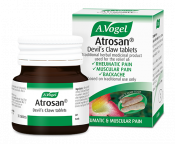
Relieves muscle & joint pain, backache and lumbago. Also available in 60 tablet size.
More info

UK 5-day pollen forecast
Stay up to date with the latest pollen information by finding your local pollen forecast from over 30,000 locations across the UK.
Supporting a healthier happier you