Why do protein bars make me bloated?
Protein bars are marketed as the perfect healthy snack. They’re convenient, packed with protein, often low in sugar, and seemingly an easy way to support your fitness and nutrition goals.
However, many protein bars are ultra-processed foods (UPFs), and some of the most heavily marketed “high-protein” options are also packed with ingredients that may not not go hand-in-hand with optimal gut health.
I’ve scoured the shelves and compared some of the more natural options, and one thing becomes clear pretty quickly: a high-protein label doesn’t necessarily mean a high-quality food.
So, if you regularly reach for a protein bar and find yourself feeling bloated, gassy or uncomfortable afterwards, could the ingredients be contributing?
Let’s look at three potential reasons why protein bars might be leaving your gut feeling less than happy, and what to look for when choosing a better option.
1. Zero-Calorie Fillers and Sweeteners: The Hidden Cost of “No Added Sugar”
One of the biggest selling points of many protein bars is that they contain little or no added sugar.
But if they taste incredibly sweet, you might reasonably wonder: what’s providing all that sweetness?
The answer is often a combination of low-calorie sweeteners and sugar alcohols, such as maltitol, sorbitol, erythritol or xylitol. Some products also use high-intensity sweeteners, including sucralose, stevia or acesulfame-K.
And these ingredients don’t all behave in the same way once they enter your digestive system.
Sugar alcohols, in particular, can be incompletely absorbed in the small intestine. The unabsorbed portion can draw water into the bowel and, depending on the type and quantity, be fermented by gut bacteria. This can contribute to gas, bloating, abdominal discomfort and changes in bowel habits.
That’s why a protein bar labelled “sugar-free” can still leave you feeling rather uncomfortable.
Some sweeteners are being investigated for their potential ill-effects on the gut microbiome, as well as out wider metabolic health. (1)
However, it’s worth asking a simple question: do we really need our everyday snacks to taste this sweet?
Our food environment has changed rapidly, and modern products can deliver levels of sweetness and combinations of ingredients that would be unusual in a traditional whole-food diet.
Even when an ingredient is described as natural, that doesn’t automatically mean that unlimited quantities are beneficial.
2. All That Protein: Does the Source and Processing Matter?
Protein is essential. It supplies the amino acids your body needs to build and repair tissues, maintain muscle and support countless other functions.
But the amount of protein on the front of a packet doesn’t tell you the whole story.
Many protein bars rely on concentrated protein ingredients, including whey protein concentrate, whey protein isolate, milk protein, casein or other processed protein sources.
These ingredients aren't inherently bad. In fact, they can be useful ways to increase protein intake. However, the type of protein, the rest of the ingredient list and your individual digestive tolerance all matter when we look at the bigger picture.
What about stomach acid and digestion?
Protein digestion begins in the stomach, where stomach acid helps unfold proteins and activates pepsin, an enzyme involved in breaking them down.
Some people have conditions or take medications, such as proton pump inhibitors (PPIs), that reduce stomach acid. Stress can also directly affect digestive symptoms and gut function. So, if you're already prone to digestive discomfort, a concentrated protein snack, especially an ultra-processed one, may not always sit comfortably.
Is highly processed protein even less helpful?
A protein bar isn't simply a scoop of protein. It may combine concentrated proteins with sweeteners, added fibres, fats, emulsifiers, binders and other ingredients to create its texture, flavour and shelf life.
This overall artificial matrix in which proteins are bound within protein bars, may affect how successfully the protein is digested and how accessible its amino acids are. Ultimately, many people consume protein in a bid to acquire the essential amino acids we need to acquire from our diet. However, the type and quality of the protein within these produtcs may also be questionable.
A recent study investigating protein quality in processed protein products raises questions about whether some products deliver the nutritional value consumers might expect from their headline protein content. (2)
Plus, if a bar gives you a little extra protein but comes with a long list of ingredients that leave you bloated, it may be worth considering whether you could get that protein from a simpler food instead.
Wholefoods such as eggs, yoghurt, fish, tofu, beans, lentils, nuts and seeds can all contribute to your daily protein intake, depending on your dietary preferences and tolerance.
3. Added FODMAPs and Prebiotics: When “Gut-Friendly” Ingredients Cause Bloating
This is perhaps my most confusing one point, because some of the ingredients that can trigger bloating are often promoted as beneficial for gut health.
Think inulin, chicory root fibre and other added prebiotic fibres.
Prebiotics can support beneficial gut microbes, and dietary fibre is an important part of a healthy diet. So why might they cause discomfort in a protein bar?
The answer lies in the type of fibre, the amount you consume and how your individual gut responds.
What are FODMAPs?
FODMAPs are fermentable carbohydrates that are poorly absorbed, or absorbed slowly, in the small intestine. They include certain oligosaccharides, disaccharides, monosaccharides and polyols.
Because some of these carbohydrates aren't fully absorbed, by the time they reach the large intestine, they can draw water into the intestine and be fermented by gut bacteria, producing gas.
For many people, this is simply part of normal digestion. But for others, particularly those with irritable bowel syndrome (IBS) or heightened gut sensitivity, the resulting gas and changes in intestinal water content can be too extreme, and trigger bloating, pain or altered bowel habits.
Why protein bars with added FODMAPs could prove problematic
Ingredients such as inulin and chicory root fibre are often added to protein bars to boost fibre content, improve texture or help replace sugar.
Although these fibres can have benefits, they can also be highly fermentable.
The issue may be the dose. A small amount of a fibre in a varied diet might be perfectly manageable, while a concentrated amount added to a single snack could push you beyond your personal tolerance.
This can be particularly noticeable if your usual diet is relatively low in fibre and you suddenly introduce large amounts, or if you already have a sensitive digestive system.
It's also worth remembering that not all fibres behave alike. Some are more rapidly fermented than others, and individual responses can vary considerably.
More fibre isn't always better if the type and amount don't suit your gut.
That doesn't mean you should avoid prebiotics or fibre altogether. Rather, it means that a product labelled “high fibre” or “gut-friendly” isn't automatically the right choice for everyone.
Research to explore: FODMAPs and gastrointestinal symptoms.
How to Read a Protein Bar Label: What to Look For and What to Question
So, where do you go from here?
You don't need to memorise every food additive or avoid every packaged snack. Instead, start by looking beyond the marketing claims on the front of the packet and checking the actual ingredients.
Here's my practical guide to the ingredients and features worth considering:
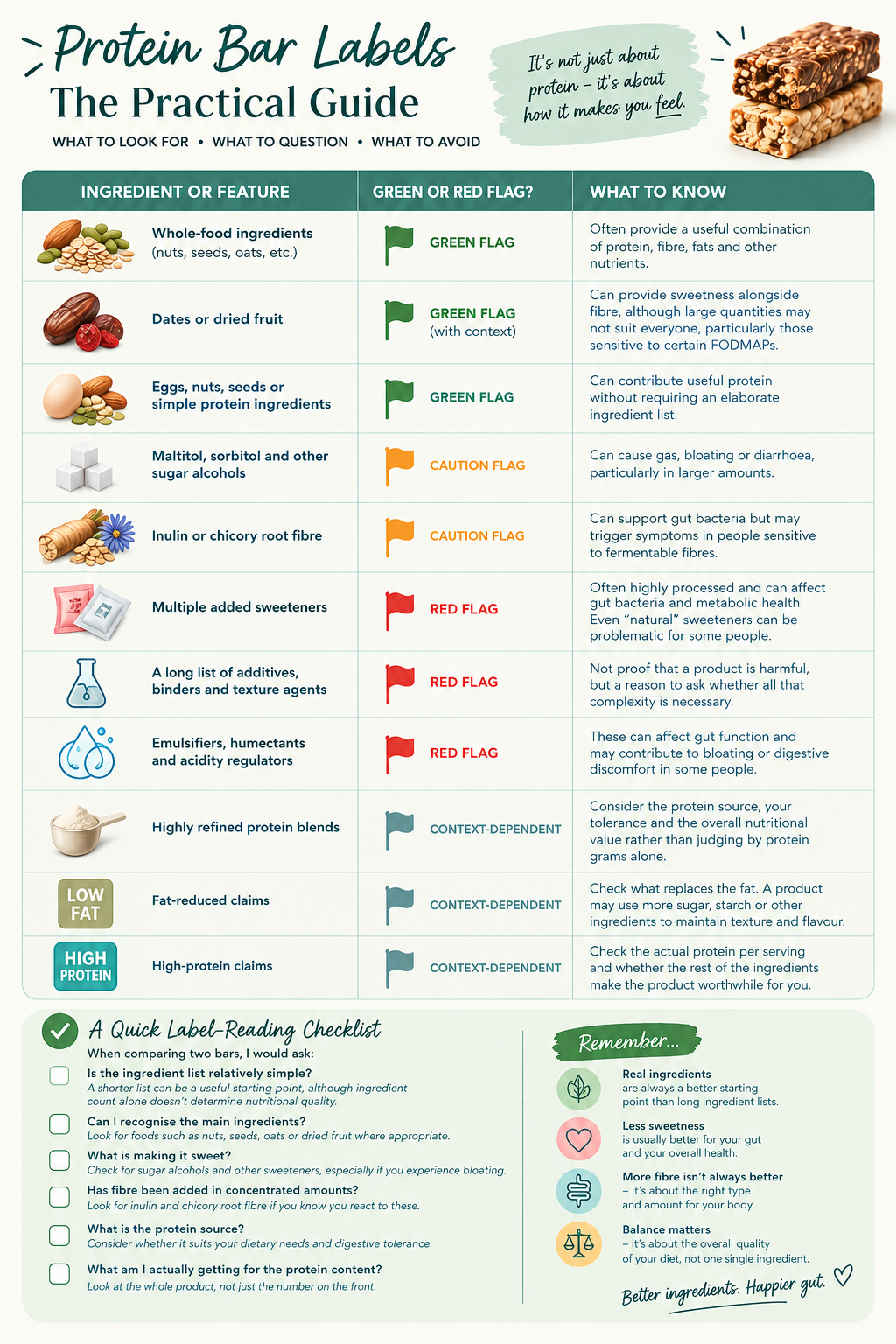
My Approach: Real Fibre Over Protein Hype, Real Ingredients Over Marketing
I’m not anti-protein. Far from it.
Protein is important, and protein bars can be useful for travel, busy days or situations where convenient food is genuinely needed.
But I do question whether squeezing an extra 10 grams of protein into a snack is always worthwhile if it means turning a relatively simple food into a highly formulated product that doesn't agree with you.
For many people, there are easier ways to increase protein intake without relying on a bar for every snack.
And natural fibre deserves just as much attention. It supports bowel function, contributes to a varied diet and can help nourish the gut microbiome, when incorporated into a diet in the right way. The goal isn't to maximise fibre or protein at all costs, but to find a balance that works for your body, and often the natural approach can work better.
Here's how I think about the bigger picture:
- Whole foods over unnecessary complexity. Choose ingredients that provide nutritional value beyond a headline claim.
- Natural sweetness over excessive sweetness. Dates and fruit can be useful options, but remember that natural ingredients can still trigger symptoms in sensitive individuals.
- Fibre-rich foods over protein hype. Prioritise a varied range of wholefood fibre sources rather than relying solely on concentrated additions.
- Nutritionally useful fats over automatic fat avoidance. Nuts, seeds and other minimally processed fat sources can be valuable parts of a balanced diet.
- Food quality over calorie-counting alone. Calories matter, but they don't tell you everything about the nutritional value of a food.
One important clarification: I'm not suggesting that sugar is automatically healthier than sweeteners, that all fats are beneficial or that every additive is harmful. The quality of the overall diet, the amount consumed and your individual needs matter far more than any single ingredient rule.
What If Protein Bars Consistently Make You Bloat?
If you notice a pattern, try looking at the specific bar and its ingredients rather than immediately cutting out all protein or fibre.
You could compare your usual bar with a simpler alternative, change one variable at a time and keep track of symptoms. This may help you identify whether a particular sweetener, fibre or protein source is contributing. And if you're struggling to meet your protein requirements, unsure how much you need or finding that many supposedly healthy foods upset your digestion, you don't have to navigate it alone. Of course nutritionists can also help offer advise on these areas on a more individualised basis.
If bloating is persistent, severe or accompanied by symptoms such as unexplained weight loss, blood in your stools, ongoing vomiting or significant changes in bowel habits, it’s time to seek medical advice.
 Looking for a healthier alternative to regular salt? Well, look no further!