1. Dry Eyes
Dry eyes are probably the most common eye symptom that I hear about.
Falling oestrogen can affect the quality and quantity of your tears. This means your eyes are less lubricated and can start to feel gritty.
You might find that they're really uncomfortable. They can feel dry, and you may notice that you're producing fewer and fewer tears.
I noticed my eyes were getting a bit drier when I was flying. I find now that my eyes get really, really dry when I'm on a plane, which they never used to.
Another thing that can happen is something called a chalazion. Around our eyes there are oil glands, and these can become blocked. These glands also play a role in keeping the eyes lubricated.
Sometimes these little oil ducts can develop lumps. This can be quite frightening when you suddenly start to find lumps forming around your eyes, but again, this is quite a common symptom. If you notice a new lump around your eye, it's worth getting it checked.
2. Watery eyes
Now, believe it or not, watery eyes can actually be caused by dry eyes.
It's the fact that your eyes are so dry that they produce more and more tears in an attempt to lubricate them. Again, this can be really uncomfortable.
You may find that when you go outside, especially if it's cold, your eyes water a lot of the time.
3. Becoming more sensitive to light
When experiencing light sensitivity, you may find that your eyes squint in the sun. You might also find that you're having to squint or half-close your eyes when you're working on a screen.
Another really common one that a lot of women tell me about is finding that driving at night, with bright lights approaching, can be really, really uncomfortable.
4. Changing vision
You might find that your vision starts to change or gets a bit blurred. You may find that you can't read particularly well and that things become more blurry.
I know for me, the point where I thought, "I think I need glasses," was when I couldn't thread a needle anymore, no matter what I did.
You might also find that you become long-sighted, or that when you look into the distance and then look close up, your vision doesn't adjust quickly enough.
5. Tired and strained eyes
You might find that you can't read as much or for as long as you used to because your eyes get tired quicker than before.
Again, this may happen when you're working on a screen. You might find that you just can't concentrate and focus enough on whatever it is you're doing close up.
How can you support your eyes during menopause?
There are some simple daily things that you can do.
Get regular eye checks
The most important thing is to get regular check-ups. In the UK, we're very lucky because many people can get free NHS eye checks, depending on their circumstances.
Even my local supermarket does them, so there's no excuse not to get this done regularly!
Also, tell them that you're in perimenopause or menopause. They can take that into account when checking your eyes and discussing any changes you've noticed.
The really important thing here, though, is don't just assume that eye changes are caused by perimenopause and menopause. There can be lots of other reasons as well.
Try lubricating eye drops
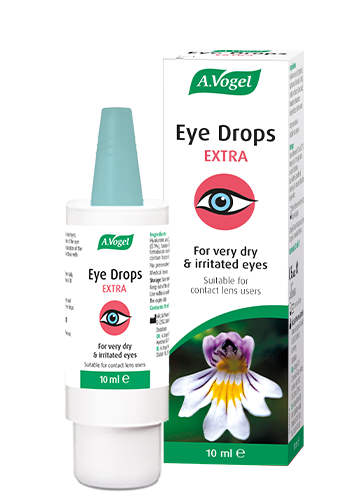
You can try lubricating the eyes with eye drops if you're experiencing dryness or irritation.
We have our Extra Moisturising Eye Drops, which contain hyaluronic acid and the herb eyebright, and these are known to soothe dry, irritated eyes.
Try a warm eye mask
I've been told that this can be really soothing, and it's also a good excuse to have five minutes' peace to yourself every day!
You can use a warm compress or buy masks that you can heat up.
For chalazions especially, this can be really, really helpful.
You can also try a gentle eyelid massage. Start on the outside of the eyelid and very gently massage towards the inner eye, and then back out again underneath the eye.
You could do this two or three times a day, and it can really help too.
Take regular breaks from screens
A really good tip is the 20-20-20 rule. Every 20 minutes, look away from the screen and look at something around 20 metres away in the distance for 20 seconds.
This helps to refocus your eyes and can really help if your eyes are starting to get that little bit tired.
Look at your diet
Your eyes need significant amounts of what's called antioxidants to help with your sight and general eye health. So, include lots of good antioxidant-rich foods in your diet.
Think colourful fruit and vegetables, leafy greens, nuts and seeds, and oily fish.
Some people find that a vitamin A supplement may be helpful.
Remember to drink enough water
This is really important because dehydration can contribute to dry eyes.
It's amazing how quickly making sure you're drinking enough water on a daily basis can help if your eyes are feeling dry.
Consider herbs and supplements
You can also look at herbs and supplements.
There's a lovely eye herb called Euphrasia, also known as eyebright, which is taken internally and can help with dry, irritated and red eyes. Euphrasia can also be useful if you get eye allergies, such as hay fever.
We also have a supplement called Vision Complex, which contains compounds called lutein and zeaxanthin, which are known to be helpful and important for eye health.
Bilberries are another one. A daily portion of bilberries can be really good too.
For really dry eyes, sea buckthorn oil supplements can be fabulous as well.
Don't ignore changes to your eyes
The really important thing here is, do not ignore eye changes.
Don't just say, "Oh, it's the menopause and I'll sort it out at some point." Get checked out, especially if you notice really sudden eye changes.
If you get little lumps that may be chalazions, get these checked out as well.
The problem here is that, as we age, other health conditions can affect our eyes too. These can include things like diabetes, high blood pressure, macular degeneration and cataracts.
So again, regular eye checks are going to pick these things up quickly, so that they can be dealt with sooner rather than later.
Have you noticed changes to your eyes?
Eye changes can be a really common part of perimenopause and menopause, but they're not always recognised as a menopause symptom.
How did you get on with your eyes? Did you have any of these symptoms? What did you do to help yourself? Did you experience other symptoms that I've not mentioned?
I'd love to hear about your experience. Share what eye symptoms you've experienced and what you've found has helped you.
Other articles you might find helpful:
10 Strange Menopause Symptoms Nobody Warns You About
Menopause and Feeling Overstimulated: Why Sound, Light, Smell & Touch Feel Too Much